
Kuala Lumpur, Malaysia — Professionals Rope Access Community (PRAC) announces the establishment of its ISO 22846-1:2003 and ISO 22846-2:2012
conformance audit framework, designed to assess rope access operations against internationally recognized guidance for rope access systems and work
positioning practices.
The framework is structured to provide an independent, principles-based conformance review approach aligned with ISO 22846 guidance. It is intended to support organizations in evaluating the effectiveness of their rope access management systems, operational controls, and safety governance structures within the context of established international best practices.
ISO 22846 outlines fundamental requirements and recommendations for the safe use of rope access techniques, including system design, operational
planning, supervision arrangements, personnel competence, equipment integrity, and emergency preparedness. The PRAC audit framework translates
these principles into structured assessment criteria that can be applied consistently across industrial environments.
Rather than functioning as a certification scheme, the PRAC conformance audit framework is positioned as an operational assurance and improvement tool. It is intended to help organizations identify gaps in implementation, strengthen internal control systems, and improve the reliability of documented safety
and operational processes.
The scope of PRAC conformance audits includes structured evaluation across key operational domains:
• Rope access system implementation and operational compliance
• Safe system of work design and application
• Site documentation, procedural control, and record integrity
• Competency assurance, training validation, and supervision effectiveness
• Equipment management, inspection control, and PPE governance
• Emergency preparedness and rescue planning capability
• Evidence-based traceability and operational documentation systems
• Corrective action tracking and continuous improvement mechanisms
Through this framework, PRAC aims to support organizations in developing more robust and verifiable rope access governance systems. The emphasis is
placed on practical implementation, operational discipline, and alignment between documented procedures and field-level execution.
As rope access continues to be widely adopted across construction, infrastructure maintenance, energy, telecommunications, and industrial service sectors, the need for structured conformance assessment mechanisms has become increasingly relevant. Organizations are expected to demonstrate not only procedural compliance but also effective execution of safety-critical controls and competency-based supervision systems.
The PRAC conformance audit framework is intended to support this evolving industry requirement by providing a structured reference model for reviewing
operational maturity and identifying opportunities for improvement. It complements existing internal audit systems and safety management practices without replacing statutory or regulatory obligations.
This initiative reflects PRAC’s continued focus on strengthening rope access safety governance, advancing competency standards, and supporting the development of more consistent and transparent operational practices within the industry. PRAC will continue to engage with industry stakeholders, technical practitioners, and operational leaders to refine and enhance the framework in line with evolving international guidance and sector needs.
PRAC ACM Programme Highlights the Future of Working at Height Through Automation
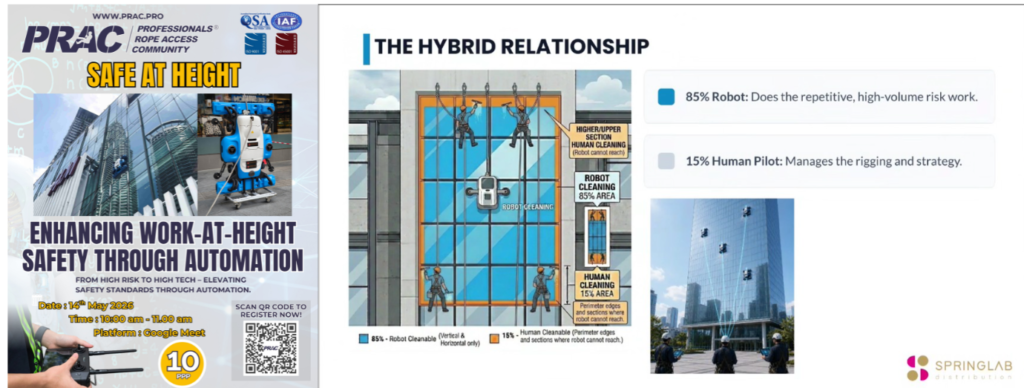
14 May 2026 — Professionals Rope Access Community (PRAC) successfully hosted an Advisory Committee Members (ACM) Programme featuring a knowledge-sharing session by Lance Chen, an Operations Strategist with expertise in robotic automation for high-risk industrial environments.
The session, titled “Enhancing Working at Height Through Automation,” focused on how modern technologies such as facade maintenance robotics, smart monitoring systems, and automation solutions can help improve safety, reduce human exposure to high-risk areas, and enhance operational efficiency in the working at height industry.
During the programme, Lance Chen shared valuable insights on the role of automation in supporting safer work practices, particularly in industries where workers are exposed to height-related hazards. The discussion highlighted that while automation can significantly reduce risk and improve productivity, competent and certified personnel remain essentialto ensure proper operation, supervision, maintenance, and compliance with safety standards.
The session also emphasized how technology-driven safety practices support Environmental, Social and Governance (ESG) objectives by promoting safer workplaces, reducing operational risk, and encouraging more sustainable industrial practices.
Through this ACM Programme, PRAC continues to strengthen industry awareness, professional development, and collaboration among safety practitioners, industry leaders, and technology experts.
PRAC remains committed to advancing “The Way of Safety” by promoting practical, future-ready, and industry-relevant solutions for working at height.
Looking ahead, PRAC will continue its commitment to advancing industry knowledge and promoting safer work-at-height practices through its upcoming ACM Programme, titled “Safe Gondola Operations,” scheduled for 16 June 2026 from 10:00 a.m. to 11:00 a.m. via Google Meet.
The programme will provide participants with valuable insights into the safe operation of gondola systems, covering key topics such as hazard identification, risk control measures, pre-operation inspections, emergency preparedness, regulatory requirements, and industry best practices. As gondolas remain one of the most widely used access systems for façade maintenance, cleaning, inspection, and construction activities, ensuring their safe and effective operation is essential in preventing accidents and maintaining a safe working environment.